
Homes, garages and pole barns across Marion County and the suburbs
Spray Foam Insulation in Indianapolis, IN
Seal the leaks that make Indianapolis houses cold in January and sticky in July, with foam where it pays and loose fill where it does the job for less.
- Free on-site estimates
- Written quotes that list material, thickness and R-value for each area
- Air leaks, moisture and old insulation checked before anything is covered
Insulation for Hot, Humid Summers and Cold Winters
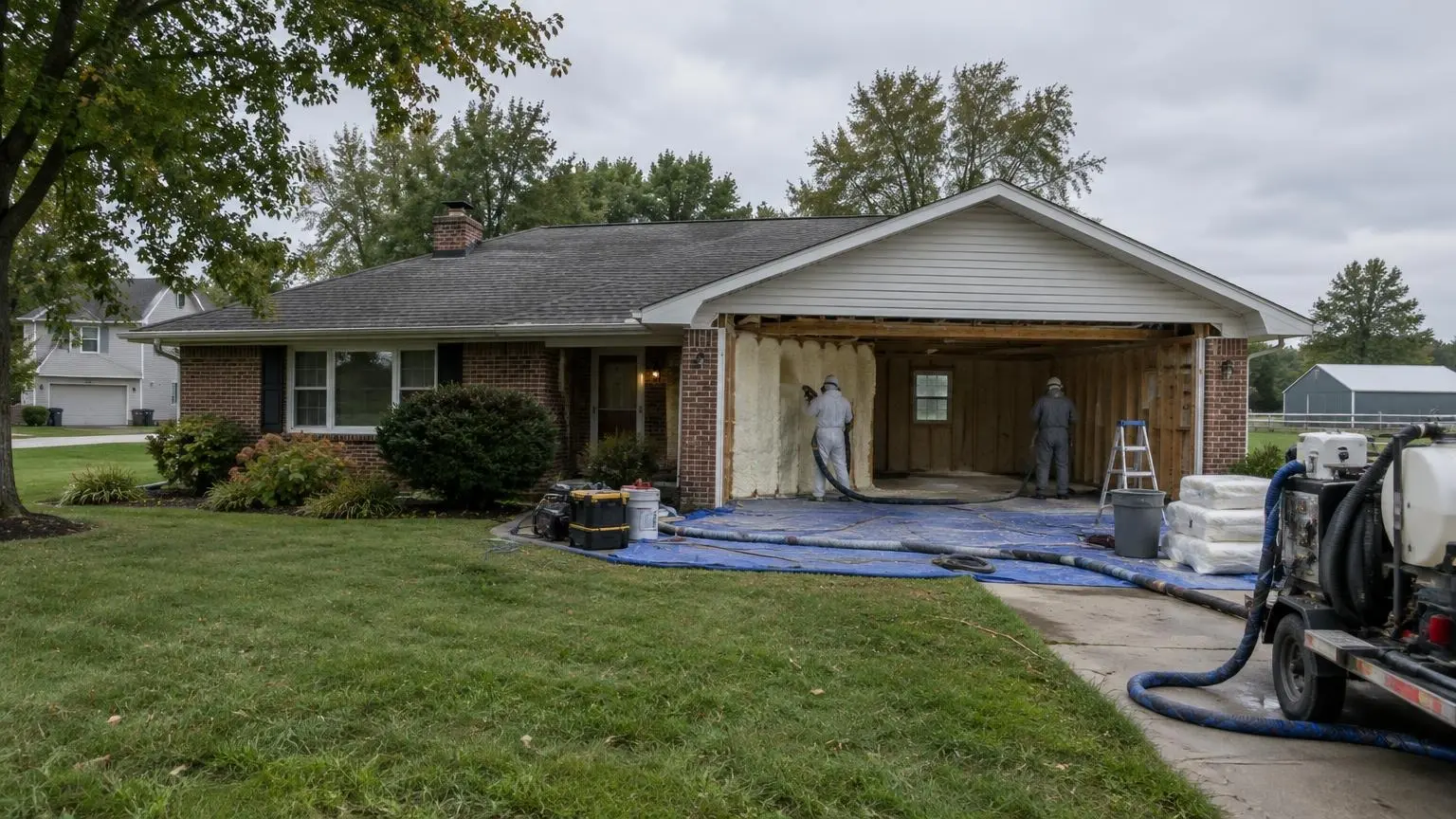
Spray foam insulation in Indianapolis has to handle two seasons that pull in opposite directions. Wikipedia's 1991-2020 climate table for the city shows a January mean low of 20.9F and a record low of -27F, a July mean high of 85.2F and a record high of 106F, and an average relative humidity of 72.3%. A leaky house bleeds heat from December to March and draws damp, hot air into the attic and crawl space from June to September. Our job is to find those leaks, close them, and insulate the spaces that need it, with open-cell or closed-cell spray foam on the surfaces that call for it and blown-in insulation wherever that reaches the same result for less money.
What the code asks for in Indianapolis
Marion County and the counties around it (Hamilton, Hendricks, Boone, Johnson, Hancock, Morgan, Shelby and Madison) sit in IECC Climate Zone 5A, per the county list on OpenEI. The Insulation Institute's summary of the Indiana energy code says the 2020 Indiana Residential Code, based on the 2018 IRC, took effect December 26, 2019. For Zone 5 it lists R-38 for ceilings, R-20 or R-13 plus R-5 for wood-frame walls, and R-13 or R-10 continuous for basement and crawl space walls. Those are minimums for new work. For an existing attic, the Department of Energy recommends R-60 in Zone 5 if the attic has no insulation, and adding R-49 where 3 to 4 inches already lie on the floor.
Where Indianapolis houses leak
Wikipedia notes that nearly 100,000 housing units were built in Marion County between 1950 and 1970, mostly outside Center Township in areas like Castleton, Eagledale and Nora. Those ranches, split-levels and two-stories make up a big share of the homes we see, and most sit over a vented crawl space or a basement. The leaks are predictable: an uninsulated rim joist around the whole foundation, open crawl space vents, an attic hatch with no seal, and gaps around plumbing stacks, flues, wiring and recessed lights. Older homes closer to downtown add open wall cavities and balloon framing that let air run from the basement to the attic. Newer suburban homes tend to leak at the floor over the garage, around attic hatches and through the kneewalls of bonus rooms.
Closed cell vs open cell
Open-cell foam is soft and spongy. It fills a cavity and blocks drafts, yet lets vapor pass, and HomeGuide rates it R-3.5 to R-3.7 per inch. Closed-cell foam is rigid and heavy by comparison, rated R-5 to R-7 per inch, and a couple of inches of it resists vapor and sheds water. Around Indianapolis that points closed-cell at band joists, crawl space and basement walls, shallow roof decks and steel buildings, and open-cell at stud walls, floors between rooms and some attic rooflines where moisture is handled separately. Each quote names the foam we would use in each area and why.
Crawl spaces and summer humidity
Indianapolis summers are damp, and much of the region sits on till-plain soils like the Crosby series, which the USDA describes as somewhat poorly drained with a perched water table 0.5 to 2 feet down in winter and spring. Put those together and a vented crawl space often runs wet: moist outdoor air comes in through the vents and condenses on cool ductwork and floor framing, and ground moisture comes up through bare dirt. A closed crawl space with a sealed vapor barrier and insulated walls usually stays drier and keeps the floor above it warmer. We check for standing water and grading problems first, because insulation does not fix drainage.
Spray foam insulation cost
HomeGuide's 2026 guide puts installed spray foam between $1.50 and $5.00 a square foot, with open-cell at $1.50 to $3.50 and closed-cell at $3.00 to $5.00. The same guide prices band joists at $2,000 to $2,500, a crawl space at $2,000 to $4,000 and an entire house at $8,000 to $20,000, and says many installers charge a minimum of $1,000 to $2,000 or more. Fixr's 2025 numbers for existing homes run higher, at $3.15 to $7.50 per square foot. Keep in mind that a 2,000 square foot house is not 2,000 square feet of foam; the surfaces actually sprayed (attic, walls, band joist, crawl space) drive the total, which is why we measure on site. The written estimate is what you pay.
Insulation contractors: what to ask before you hire
When you call spray foam insulation contractors or insulation companies around Indianapolis, a few questions separate the careful ones from the rest. Which gaps get sealed before any insulation goes in, and with what? Which foam goes where, and why that one? What depth and R-value are written on the quote? How will attic and crawl space ventilation be handled? How long should the household be out after spraying (HomeGuide suggests a full day or more)? What becomes of old insulation that is damp or dirty? Are prices broken out area by area so two bids can be compared line for line? If someone searching for spray foam insulation near me gets a fuzzy answer to any of these, it is worth pressing. We answer all of them in writing on every job.
Rebates worth checking
AES Indiana's attic insulation rebate page lists $0.325 per square foot for attics starting at R-12 and $0.42 per square foot for attics starting at R-11 or less, insulated up to R-49, for current AES Indiana residential customers whose homes are all electric. The page does not show dates, so check it before the job. Other utility programs in the area change from year to year; we can help you gather the measurements a rebate form asks for.
Towns We Serve Around Indianapolis
We work across Indianapolis and the excluded cities inside Marion County (Lawrence, Speedway and Beech Grove), north into Carmel, Fishers, Noblesville, Westfield, Zionsville and Whitestown, east to McCordsville and Greenfield, south to Greenwood, Franklin, Mooresville and Martinsville, and west to Brownsburg, Avon, Plainfield and Danville. The mix of houses changes as you go: postwar ranches and crawl spaces inside I-465, gas-boom era homes in the old county seats, and subdivisions built since 2000 in Hamilton and Hendricks counties. The town pages below explain what tends to differ from place to place.
- Spray Foam Insulation in Indianapolis, IN
- Spray Foam Insulation in Carmel, IN
- Spray Foam Insulation in Fishers, IN
- Spray Foam Insulation in Noblesville, IN
- Spray Foam Insulation in Westfield, IN
- Spray Foam Insulation in Zionsville, IN
- Spray Foam Insulation in Whitestown, IN
- Spray Foam Insulation in Lawrence, IN
- Spray Foam Insulation in Speedway, IN
- Spray Foam Insulation in Beech Grove, IN
- Spray Foam Insulation in Greenwood, IN
- Spray Foam Insulation in Franklin, IN
- Spray Foam Insulation in Greenfield, IN
- Spray Foam Insulation in McCordsville, IN
- Spray Foam Insulation in Brownsburg, IN
- Spray Foam Insulation in Avon, IN
- Spray Foam Insulation in Plainfield, IN
- Spray Foam Insulation in Danville, IN
- Spray Foam Insulation in Mooresville, IN
- Spray Foam Insulation in Martinsville, IN

What We Insulate
Six kinds of work, matched area by area to your house or building, from closed-cell foam on a rim joist to pulling out an attic's worth of tired insulation.
Spray Foam Insulation
Open-cell and closed-cell foam that insulates and air seals in one layer, matched to each surface.
Learn more →Attic Insulation & Air Sealing
Seal the attic floor first, then bring the insulation up to a depth that fits Climate Zone 5.
Learn more →Crawl Space Insulation & Encapsulation
Close the vents, seal the ground and insulate the walls so the crawl space stays dry and the floor above stays warm.
Learn more →Basement & Rim Joist Insulation
Closed-cell foam on the rim joist and basement walls, the easiest win in most basements.
Learn more →Pole Barn & Garage Insulation
Closed-cell foam on steel and framed walls so barns, shops and garages stay usable and stop dripping.
Learn more →Insulation Removal & Replacement
Pull out wet, dirty or rodent-damaged insulation so the attic or crawl space can be sealed and redone right.
Learn more →Common Questions
How much does it cost to spray foam a 2,000 sq ft house?
It depends on which surfaces get foam, not the floor area. HomeGuide's national figure for a whole house is $8,000 to $20,000, and Fixr's is $10,000 to $30,000. Many Indianapolis homes only need foam in a few places, like the rim joist, crawl space walls or kneewalls, with blown-in on the attic floor, which costs far less. We measure and send a written price.
How much would it cost to spray foam a 20x20 garage?
Add up the wall and ceiling area you want covered and multiply by the foam price: HomeGuide lists $1.50 to $3.50 per square foot for open-cell and $3.00 to $5.00 for closed-cell. A 20x20 garage with 9-foot walls has about 720 square feet of wall plus 400 of ceiling. Doors, windows and the foam thickness change the number, and many jobs hit a minimum of $1,000 to $2,000 or more.
Why do some people call spray foam a red flag?
Usually because of foam sprayed on the underside of a roof deck, which hides the sheathing from inspectors and can hide a leak, or because of bad installs that were mixed wrong or sprayed too thick in one pass. A careful job fixes leaks first, follows the maker's thickness limits and documents what went where. We put the foam type, thickness and location on the quote and invoice.
Should I use closed cell or open cell spray foam?
Around Indianapolis, closed-cell is the common choice for band joists, crawl space and basement walls, steel buildings and roof decks with no vent space, because it resists vapor and gives more R-value per inch. Open-cell is cheaper and suits stud walls, above-grade cavities and some rooflines. The quote lists which foam goes in which area.
What R-value does an Indianapolis attic need?
The 2020 Indiana Residential Code lists R-38 for ceilings in Climate Zone 5, which includes Marion County. For an existing attic, the Department of Energy recommends R-60 in that zone if there is no insulation and adding R-49 over 3 to 4 inches of old fill. We measure what you have and write the target on the quote.
Should I close up my crawl space?
In many Indianapolis homes, yes. Vented crawl spaces pull in humid summer air, and much of the area sits on poorly drained till soils. A sealed vapor barrier, closed vents and insulated walls usually keep the space drier and the floor warmer. Standing water or drainage problems get fixed first.
How long do we need to stay out of the house after spraying?
HomeGuide suggests allowing at least a full day while the foam cures. A detached garage or barn job usually does not affect the house. We go over timing for your specific job before scheduling.
Does AES Indiana offer an insulation rebate?
AES Indiana's attic insulation rebate page lists $0.325 or $0.42 per square foot depending on the starting R-value, for residential customers whose homes are all electric. Check the page for current terms before the job; we can provide the measurements the form asks for.
Why Homeowners Call Indianapolis Spray Foam Insulation
A visit before a number
We price the job only after seeing the attic, crawl space, basement or building in person.
Seal first, insulate second
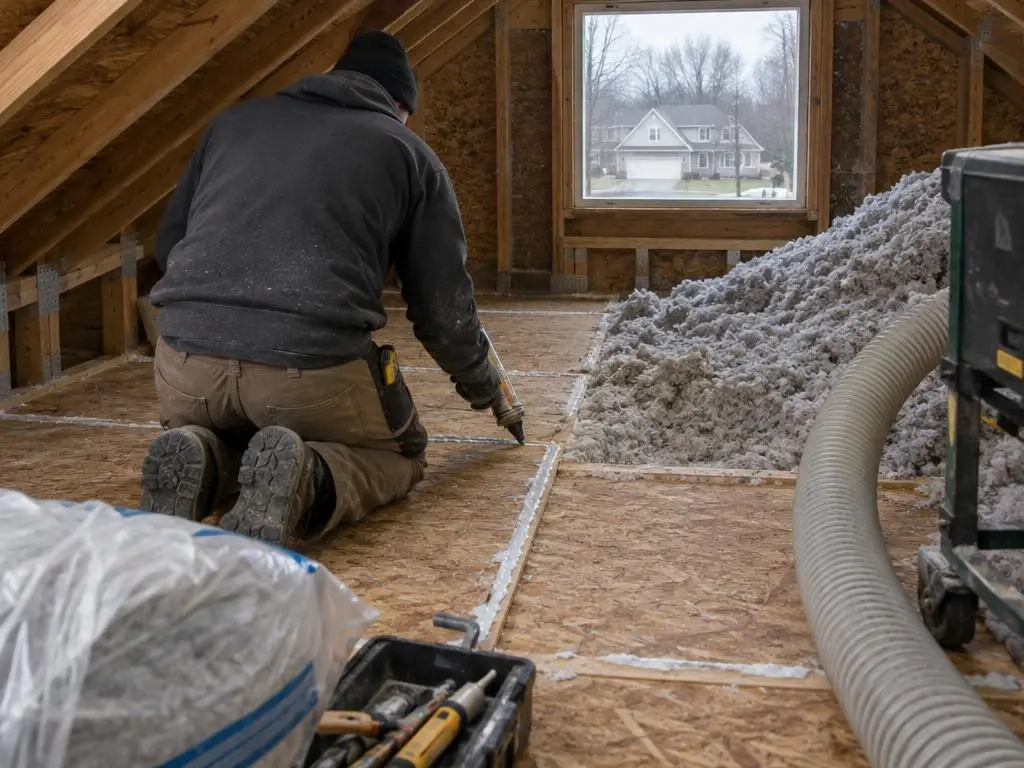
Hatches, chases, top plates, rim joists and crawl space vents get sealed before new insulation goes over them.
The material fits the spot
Closed-cell, open-cell, cellulose or fiberglass, chosen for each surface and its moisture exposure, and the reasoning is on the quote.
A quote you can compare
Each area shows material, thickness or depth, target R-value and price on its own line.
Get a Written Spray Foam Insulation Quote
We come out, look at the spaces, and send a written price that lists the material and R-value for each area.